
Karol Antonio & Citadel Muñoz-Cruz
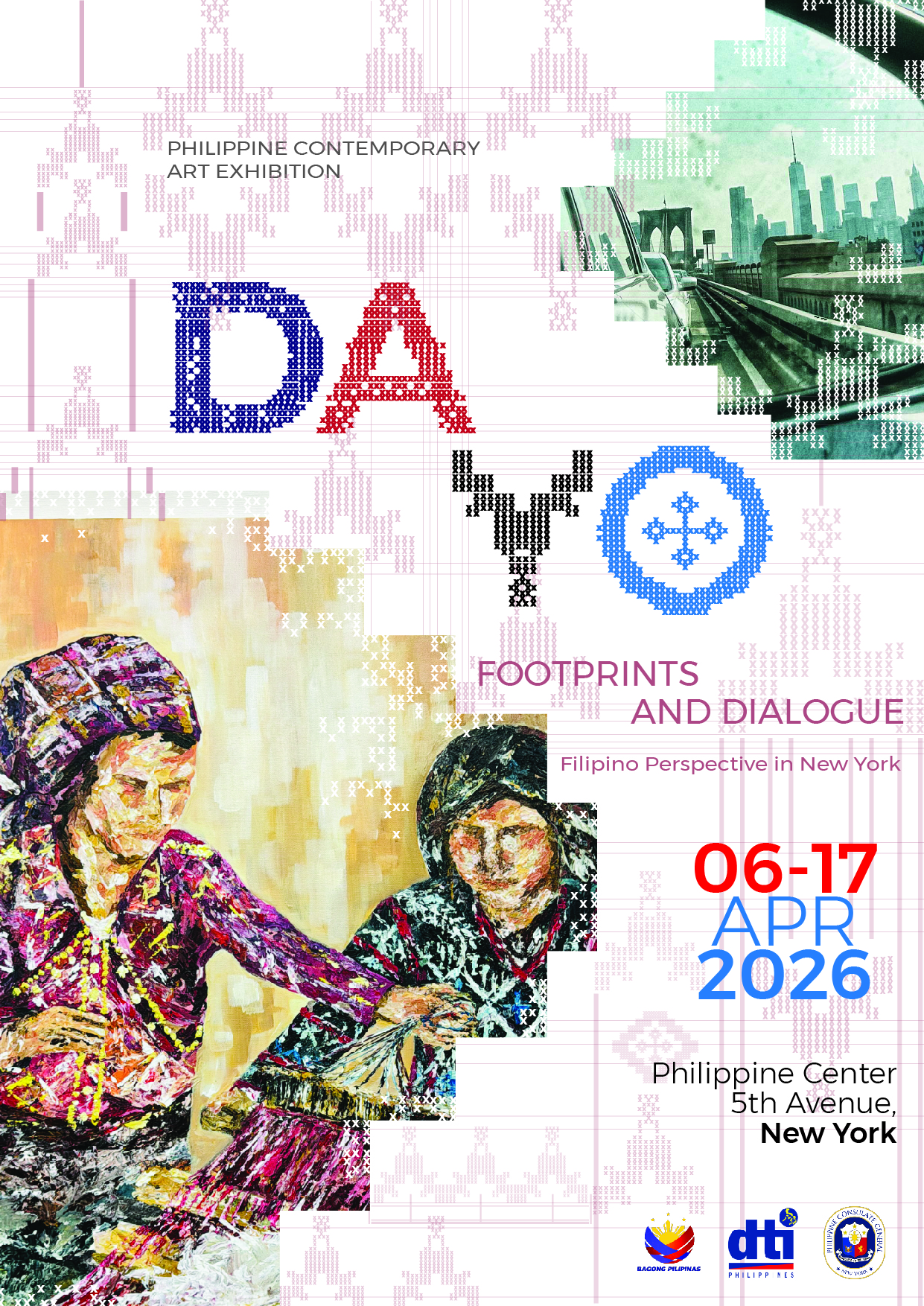
DAYO: FOOTPRINTS AND DIALOGUE
April 8, 2026 Opening Exhibition presented by the Philippine Trade and Investment Center – New York
—
To be a stranger in a city is to carry two worlds at once. Cities like New York have long drawn people from elsewhere — those who arrive not merely to visit but to plant themselves, however tentatively, in unfamiliar ground. The question of what remains, and what is left behind, has occupied artists across cultures and centuries. What marks does a person leave on a place? What marks does a place leave on a person? In the Filipino language, dayo carries both meanings at once: to arrive from somewhere else, and to find oneself, through that very act of arrival, transformed.
DAYO: Footprints and Dialogue take up these questions through the lens of Filipino presence in New York. Working across painting, printmaking, textile, embroidery, and photography, artists Karol Antonio and Citadel Muñoz-Cruz trace the lived experience of migration not as rupture, but as accumulation — layer upon layer of encounter, memory, and cultural negotiation. The exhibition features a site-responsive textile installation that reimagines the city’s vertical energy through Philippine weaving traditions, alongside mixed-media works that embed indigenous textiles and Baybayin script into contemporary urban scenes. Together, the works ask what it means to belong to two places simultaneously, and how cultural identity persists, adapts, and asserts itself within one of the world’s most relentlessly forward-moving cities.
The exhibition builds on the legacy of HABI: Discovering Possibilities for Philippine Fibers, the 2024 traveling exhibition that elevated Philippine textiles within the global creative landscape. Where HABI spotlighted the materials themselves, DAYO shifts attention to the hands, lives, and longings behind them — to the people who weave, stitch, paint, and photograph their way into belonging. By reusing materials from earlier textile programs, the exhibition carries an additional charge: that sustainability, like identity, is not an endpoint but a practice, renewed in every act of making.
—
ABOUT THE ARTISTS
Karol Ann P. Antonio is a licensed interior designer, exhibition designer, artist, and educator based in Manila, Philippines. Her practice positions spatial design as a socially engaged process — not merely an aesthetic pursuit, but a means of shaping meaningful human experience. A faculty member at De La Salle–College of Saint Benilde’s School of Environment and Design, Antonio grounds her teaching in experiential learning and community engagement. Her work in DAYO draws on more than a decade of practice across professional, academic, and grassroots contexts, translating the rhythm and scale of New York’s urban landscape into the language of Philippine material culture.
Citadel Muñoz-Cruz is a self-taught artist, Baybayin teacher, and Sound Healing practitioner whose work is rooted in the healing power of nature, indigenous script, and handwoven Philippine textiles. Working in embroidery, textile assemblage, and photography, she hand-stitches Filipino words in Baybayin onto cotton denim, incorporating woven fabrics from various indigenous communities across the Philippines. Her images — quiet, grounded, and deeply felt — emerge from a practice of pausing within the noise of the city to remember who she is. Her work has been exhibited across the Philippines, the Netherlands, Germany, and the United States.
—
“I am a Filipina in New York. A Dayo for the second time. People come to New York from all over to build and transform their dreams into reality. I do often wonder how it felt for them to leave their homes behind. What did they give up? What did they have to do in order to be part of this city? At what expense?” — Citadel Muñoz-Cruz