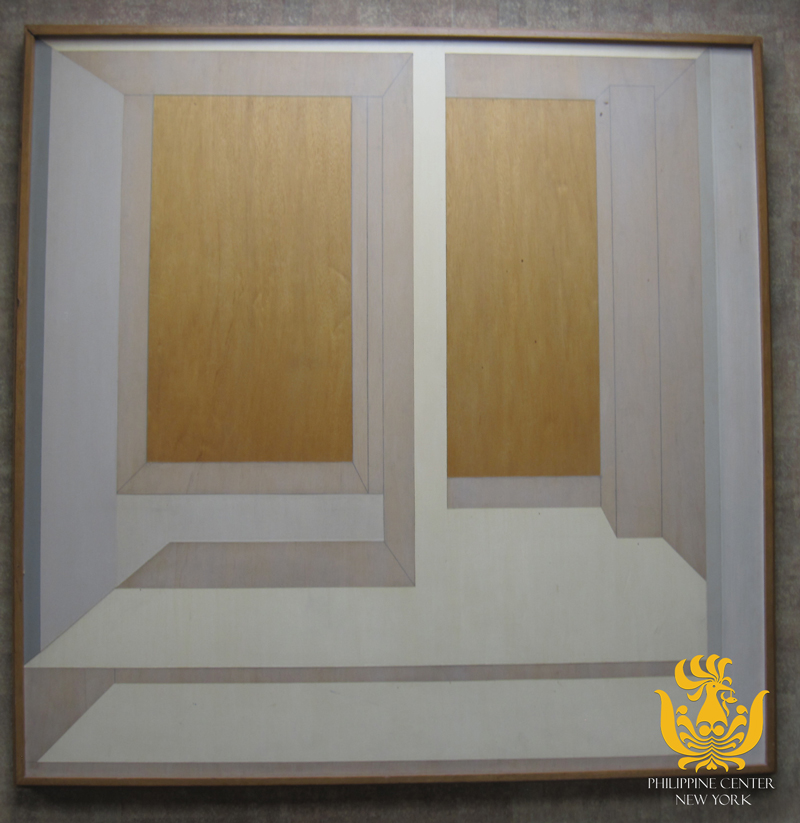
Lee Aguinaldo (1933–2007) was a pioneering figure in Philippine modern art, credited with igniting the country’s abstract movement. Born in New York City to Filipino parents, he grew up in Manila and studied at the University of the Philippines School of Fine Arts before pursuing further training in the United States.

Influenced by international currents such as Abstract Expressionism, Pop Art, Op Art, and Minimalism, Aguinaldo developed a distinctive style of hard‑edge abstraction. His bold strokes, vibrant palette, and geometric compositions dazzled audiences, bridging the gap between abstraction and emotion. Among his notable works is Homage to Pollock (1953), a tribute to the energy and innovation of Jackson Pollock.

His achievements were recognized with major awards: Second Prize for “White City” (1961), First Prize for “Explosion in Gold” (1962), and Honorable Mention for “Explosion in Red City” (1963). In 1975, the City of Manila honored him with the Patnubay ng Sining at Kalinangan Award, affirming his role as a leading voice in modern Philippine art.

Aguinaldo exhibited widely, including at the São Paulo Biennial, and was part of the circle of artists—alongside Fernando Zóbel, Arturo Luz, and Jose Joya—who helped define postwar modernism in the Philippines. His restless experimentation and fearless embrace of new styles made him one of the most dynamic artists of his generation.

Beyond accolades, Aguinaldo’s legacy lies in the continuing influence of his work. His canvases remain a touchstone for younger artists, inspiring generations to explore abstraction as a language of both innovation and emotion.